
DIY vs Professional Window Tinting in Houston, TX
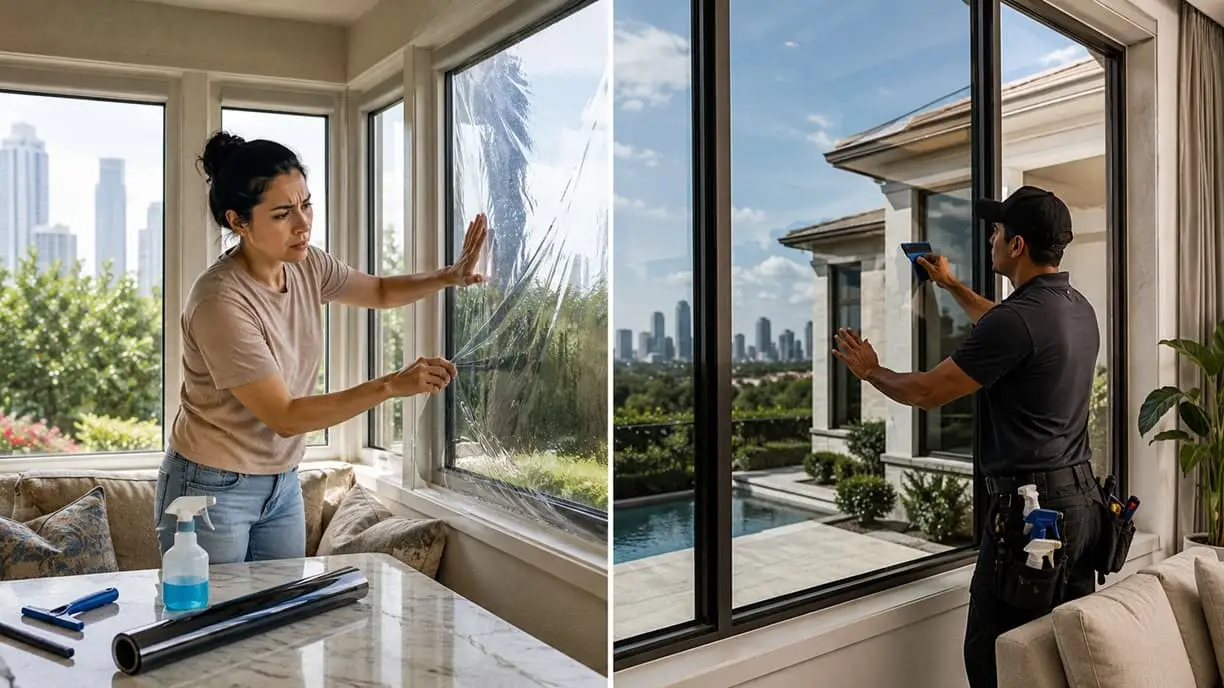
Window tinting gives you two paths: a DIY kit you apply yourself or professional installation by a trained crew. The honest answer is that DIY kits work for small, low-stakes panes, while professional installation wins on large windows, tricky glass, and any job you want to keep looking clean for years.
This guide compares the two on cost, finish quality, bubbling and peeling risk, and warranty, so you can choose with clear eyes. Greenhouse Solar Control handles window tinting in Houston and Katy for homes and businesses. Call (281) 961-3058 for a free estimate.
Book your free estimate: call Greenhouse Solar Control at (281) 961-3058.
Cost Compared: Kit vs Professional
A DIY window film kit costs less up front than professional installation, because you buy only the film and a few basic tools and supply your own labor. That gap is real, and for a single small window a kit can be the sensible pick. Professional installation costs more because the price covers measured film, the right tools, and a trained installer who controls each step.
The cost of doing it twice
The up-front number is not the whole cost, though. A DIY kit you have to redo wastes the first roll of film and your afternoon, and buying a second kit erases part of the savings.
Professional installation is priced once and done once, which is why the cheaper option is not always the lower total cost. Exact pricing depends on the glass, the film, and the number of panes, so the figure that matters is the one on your written estimate.
Finish and Risk: Bubbling, Peeling, and Alignment
Finish quality is where DIY and professional installation separate most, because the look of tinted glass depends on prep, precise cutting, and a clean wet application. A DIY kit gives you the film but not the years of practice that keep those three steps tight. When any one of them is rushed, the result shows on the glass.
Common DIY problems fall into a short, predictable list:
- Bubbles: trapped air or dust under the film, usually from glass that was not fully cleaned or a squeegee stroke that missed a spot.
- Creases: hard folds in the film from handling it dry or dropping it onto the adhesive before it is aligned.
- Peeling edges: film cut a hair too small or pressed without enough slip solution, so the border lifts over time.
- Misalignment: film set crooked on the pane, which is hard to correct once the adhesive grabs.
How a professional avoids those faults
Professional installation targets each of these before they happen. The installer cleans the pane, cuts the film to a tight border, floats it into place with a slip solution, and presses from the center out to move air and water toward the edges. That controlled wet application is the single hardest part to do by hand, and it is where most DIY jobs go wrong.
Warm glass and humid air
Houston heat and humidity make that wet application even less forgiving. Warm glass flashes the slip solution off faster, so the film can grab before it is aligned. Humid air slows the final cure and leaves more room for haze and water pockets when the set was rushed.
A DIY installer fighting both at once on a hot afternoon has thin margins, which is part of why professional installation holds up better in this climate.
The Warranty Difference
Warranty coverage is a real dividing line between DIY and professional window tinting. Manufacturers back their film with a warranty, but many require certified or professional installation for that coverage to apply. Install the film yourself, and you can void the manufacturer warranty before the film is even set.
Two layers of coverage
Professional installation protects that coverage because the work is done to the standard the warranty expects. A professional job typically carries two layers: the manufacturer warranty on the film and a workmanship warranty on the labor. Exact terms vary by film and by application, so confirm what is covered and for how long on your written estimate before work begins.
Our own workmanship warranty
To show what that second layer looks like in practice, our own workmanship carries a limited lifetime warranty on residential installations and a 10-year warranty on commercial installations, and that sits on top of whatever the film manufacturer covers. Workmanship coverage answers the failures a DIY attempt has no recourse for: a lifted edge, a crooked line, debris under the film.
A kit gives you a roll of film and no one to call. Ask any installer to put both layers in writing, because a warranty you cannot read is a warranty you cannot claim.
Our Recommendation
Choose a DIY kit for small, low-stakes glass where a flaw would not bother you, such as a tiny bathroom window or a shed pane. The film is cheap, the panes are forgiving, and a stray bubble is easy to live with. Trying a kit first is a fair way to learn what the work involves.
When to hire a professional
Choose professional installation for anything larger, more visible, or harder to replace, which covers most windows in a home or business. Big panes, specialty glass, and street-facing windows leave no room for creases or lifted edges.
Professional installation also protects your warranty and saves the cost of buying a second kit after a first attempt goes wrong. If you tried DIY and were not happy with the result, that is common, and a professional can strip the old film and start clean.
For a home, our residential window tinting page breaks down film choices by room and glass type. For whole-property heat reduction, UV protection, privacy window film, or security window film, professional installation is the dependable choice.
Frequently Asked Questions
Book Professional Window Tinting in Houston
Ready to skip the guesswork and get a clean finish that lasts? Greenhouse Solar Control provides professional window tinting for homes and businesses across Houston, TX and Katy, TX, from a single room to full commercial window tinting.
For a full walk-through of prep, application, and cure time, see our professional window film installation page. When you are ready, call (281) 961-3058 for a free estimate, and we will match the right film to every pane.