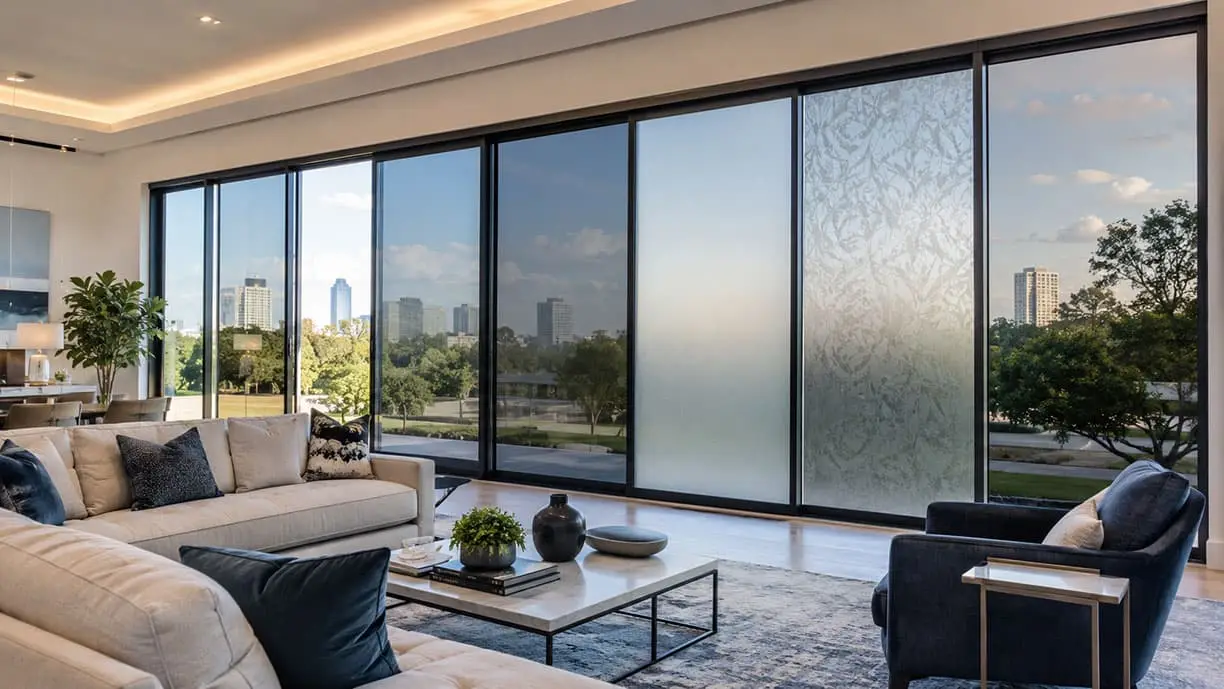
Types of window film: complete comparison guide

Types of window film — complete comparison guide

Not all window film performs the same — ceramic, security, decorative, and solar control films each solve different problems at different price points. This guide breaks down every major film type by heat rejection, UV protection, cost, and best application so you can choose the right film for your Houston home or business.

What are the main types of window film?

Window film is a thin polyester material applied to glass to modify heat, light, UV, privacy, or safety performance. It falls into seven functional categories.

Each type uses a different construction — from nano-ceramic particles to metallic layers to frosted polyester — that determines how much heat, light, and UV radiation passes through the glass. Greenhouse Solar Control installs all seven film types across residential window tinting and commercial window tinting projects in the Houston metro area.

The right choice depends on your primary goal: cutting energy costs, protecting against break-ins or storms, adding privacy, or improving aesthetics. Most Houston properties benefit from a combination — ceramic film on sun-facing windows and decorative film on bathrooms, for example. Use the interactive comparison below to explore each type's performance, cost, and best use.

Performance, cost & best uses — side by side

Select a film type to see its heat rejection, UV block, specs, ideal application, and how it performs in Houston. Ranges reflect 3M, XPEL, and LLumar products.

Heat rejection40–82%
UV block99%+
VLT range15–70%
SignalNone
Durability15–20+ yr
Cost / sq ft$8–$14
Best forHouston homes needing maximum heat reduction without a dark tint.

Ceramic window film uses nano-ceramic particles in a polyester layer to block infrared heat without reducing visible light or interfering with wireless signals. Premium ceramic films — 3M Prestige Series, XPEL VISION CeramicOne — reject up to 82% of infrared energy while allowing 40–70% visible light, so rooms stay bright without the oven effect.

It's the most-requested residential product we install in Houston. Ceramic reduces interior temperatures by 10–15°F without the mirror-like look of metalized film. The higher upfront cost is offset by 25–30% cooling savings over Houston's 6-month summer. See our full guide to ceramic window tint installation, which pairs well with heat reduction window tinting.

Heat rejection5–35%
UV block99%
VLT range50–90%
SignalNone
Durability10–15 yr
Cost / sq ft$7–$15
Best forBreak-in protection, hurricane prep, and shatter resistance.

Security film bonds a thick (4–14 mil) polyester layer to glass, holding shards in place on impact. Standard films resist blunt force from break-ins; hurricane-rated films withstand wind-borne debris tested to 130+ mph. 3M Safety & Security and XPEL VISION Security are the lines we install most in the Houston metro.

It doesn't stop glass from cracking — it stops it from falling inward, the primary injury and intrusion mechanism. Houston businesses use it for storefront protection; homeowners install it for hurricane protection window film and child safety. See our complete breakdown at security window film installation.

Heat rejection0–20%
UV block0–80%
VLT range30–90%
SignalNone
Durability10–15 yr
Cost / sq ft$5–$12
Best forBathroom privacy, conference rooms, and storefront branding.

Decorative film transforms plain glass with frosted, etched, patterned, or branded finishes without permanent alteration. Unlike sandblasting or acid etching, film is removable and replaceable — a major advantage for commercial tenants who change branding or owners updating aesthetics.

Houston applications include bathroom windows, glass office partitions, conference-room privacy, front-door sidelights, and storefront branding. Frosted film — the most popular subtype — provides day and night privacy while allowing diffused light. See decorative window film options or our frosted window tinting service.

Heat rejection35–75%
UV block95–99%
VLT range20–65%
SignalLow–Mod
Durability12–18 yr
Cost / sq ft$6–$12
Best forReducing AC costs on south- and west-facing windows.

Solar control is an umbrella category covering any film engineered primarily to reduce solar heat gain — including ceramic, metalized, and dual-reflective subcategories. The distinction is in construction, not function. Heat rejection ranges from 35% on entry-level dyed films to 75%+ on premium dual-reflective products.

Houston averages 204 sunny days per year, and CenterPoint Energy bills reach $280/month in July–August. Solar control film typically cuts cooling costs by $40–$70/month during peak season on a 2,000 sq ft home, with a 2–4 year payback. Learn more on our heat reduction window tinting in Houston page.

Heat rejection15–45%
UV block99%+
VLT range60–90%
SignalNone
Durability10–15 yr
Cost / sq ft$5–$10
Best forPreventing furniture & flooring fade without changing appearance.

UV protection film blocks 99%+ of ultraviolet radiation — the wavelengths that fade hardwood floors, upholstery, artwork, and merchandise. Clear UV films achieve this without changing a room's appearance or light level, making them the choice for museums, galleries, retail, and homes with valuable finishes.

Houston's UV index reaches 10–11 (extreme) in summer. Unprotected windows transmit enough UV to visibly fade dark fabrics within 6–12 months of direct sun. See our full guide to UV protection window film.

Heat rejection20–60%
UV block90–99%
VLT range5–50%
SignalLow
Durability10–15 yr
Cost / sq ft$6–$12
Best forGround-floor bedrooms, bathrooms, and street-facing rooms.

Privacy film restricts visibility through glass using reflective, frosted, or tinted layers. Reflective privacy film gives one-way daytime privacy — mirror-like outside, clear from inside — but reverses at night when interior lights are on. Frosted privacy film provides 24-hour obscured visibility both directions.

For Houston ground-floor bedrooms, bathrooms, and street-facing living rooms, we usually recommend dual-reflective privacy film that combines heat rejection with daytime privacy. Nighttime-critical rooms benefit from frosted or transitional options. Full details on our privacy window tinting page.

Heat rejection30–65%
UV block95–99%
VLT range20–60%
SignalBlocks Wi-Fi
Durability15–20 yr
Cost / sq ft$5–$10
Best forBudget heat reduction where signal interference is acceptable.

Metalized film uses thin aluminum or metal layers between polyester to reflect solar energy. It delivers strong heat rejection (30–65% infrared) at a lower cost than ceramic and is extremely durable — resisting scratching and delamination for 15–20 years.

The trade-off is signal interference. Metallic layers block or degrade Wi-Fi, cellular, GPS, and Bluetooth through the glass — Wi-Fi dead zones are common, and in commercial buildings it can affect point-of-sale systems. We recommend metalized film only where signal disruption isn't a concern — warehouses, storage, or rooms without wireless needs. For most Houston projects, ceramic window tint delivers equal or better heat rejection without signal interference.

Which window film is right for you?

Pick your primary goal and we'll point you to the recommended film type.

Recommended for you Ceramic window tint

For maximum performance, ceramic window tint rejects up to 82% of infrared heat with no signal interference. On a tighter budget, solar control film gives broad, cost-friendly coverage.

Get a free assessment
Recommended for you Security window film

Security window film at 8+ mil thickness with frame attachment delivers storm-rated, break-in-resistant protection that holds shattered glass in place.

Get a free assessment
Recommended for you Privacy window tinting

Privacy window tinting — reflective film for daytime-only privacy, or frosted film for 24-hour obscured visibility — keeps natural light while blocking the view in.

Get a free assessment
Recommended for you UV protection window film

UV protection window film — clear films block 99%+ of UV without changing your windows' appearance, stopping fade on floors, furniture, and artwork.

Get a free assessment
Recommended for you Decorative window film

Decorative window film — frosted, patterned, or custom-printed finishes add style and selective privacy to glass without permanent alteration.

Get a free assessment
Recommended for you Ceramic film — all three

Ceramic film covers heat, privacy, and UV in one product. Call us at (281) 961-3058 for a free assessment to find the right product match for each window.

Get a free assessment

Houston-specific film recommendations

Houston's climate narrows the film selection for most properties. Four local factors drive the choice.

Heat is the primary driver

With 204 sunny days a year, highs of 95–97°F, and 75%+ humidity, south- and west-facing windows absorb extreme solar heat gain. Ceramic film is the default residential recommendation — no signal interference, no dyed-film fade.

Hurricane season adds a security layer

June through November, properties benefit from debris-rated security film. We often install ceramic on most windows and upgrade hurricane-exposed glass to hurricane protection window film.

Commercial buildings have code considerations

Houston commercial properties must meet IBC energy code, and many landlords require films that don't alter exterior appearance. Low-reflectivity ceramic and spectrally selective films meet both. See commercial window tinting options.

UV exposure is year-round

Houston's UV index hits extreme (10–11) in summer but stays moderate (4–6) even in winter. UV film is a 12-month need here. Homes with hardwood, leather, or artwork near windows should prioritize 99%+ UV-blocking film regardless of heat goals.

Window film types — answered

Common questions about choosing and combining film types. Still unsure? Call (281) 961-3058.

Ceramic window film is the best all-around choice for Houston homes. It rejects up to 82% of infrared heat, blocks 99%+ UV, and doesn't interfere with Wi-Fi or cell signals. For hurricane-prone areas, pairing ceramic with security window film on exposed windows provides energy savings and storm protection.
Ceramic film uses nano-ceramic particles to block heat; metalized film uses thin metal layers. Both reject significant heat, but metalized film interferes with wireless signals (Wi-Fi, cellular, GPS) and ceramic does not. Ceramic costs $2–$4 more per square foot but eliminates connectivity issues — which is why it has largely replaced metalized film in homes.
Solar control and ceramic films typically cut cooling costs by 25–30% during Houston's peak summer. On a home averaging $250/month in summer electricity, that's $60–$75/month in savings. Most installations pay for themselves within 2–4 years.
Yes — we recommend it for most Houston properties. A whole-home install might include ceramic on sun-facing windows, UV protection film on north-facing windows with valuable interiors, frosted privacy film on bathrooms, and security film on sliding glass doors. We map the right film to each window during a free on-site assessment.
Ceramic and metalized films last 15–20+ years. Security and decorative films last 10–15 years. Dyed films degrade fastest — typically 5–8 years before noticeable fading. All films installed by Greenhouse Solar Control carry manufacturer warranties plus a workmanship guarantee.
Window film is fully removable without permanent glass damage. Professional removal takes 1–3 hours for a typical home, making film a practical alternative to permanent solutions like Low-E glass replacement — especially for renters, commercial tenants, or owners who may want to update film as technology improves.
Free assessment

Not sure which film type you need?

Greenhouse Solar Control has installed window film on 12,000+ residential and commercial windows across the Houston metro over 15+ years. We carry ceramic, security, decorative, solar control, UV, and privacy films from 3M, XPEL, and LLumar — and we'll recommend the right product for your windows, goals, and budget. Every consultation includes a free on-site window assessment.

(281) 961-3058