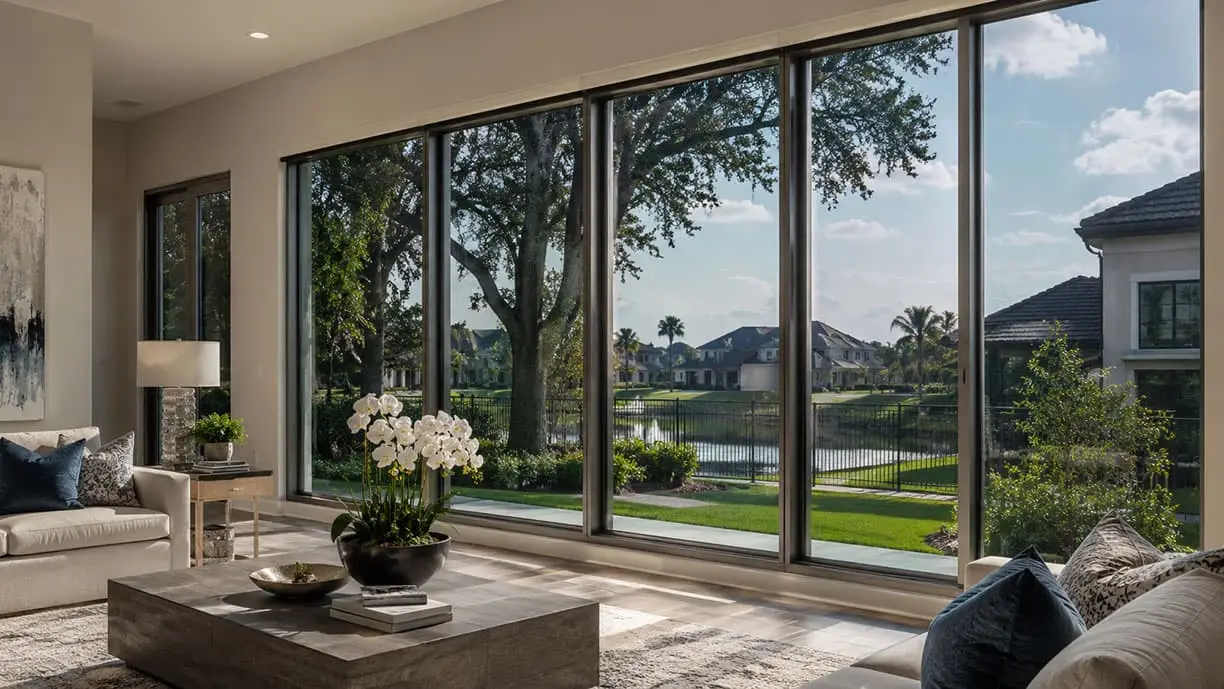
Heat Reduction Window Tinting in Houston, TX

Residential · Heat reduction film

Heat reduction window tinting blocks 40–82% of solar heat entering Houston homes through standard single-pane and dual-pane windows. Greenhouse Solar Control installs ceramic and dual-reflective heat reduction films rated to reduce interior surface temperatures by 10–15°F, cutting annual cooling costs by an estimated 25–30% based on CenterPoint Energy residential usage patterns. With 15+ years serving the Houston metro area and over 12,000 completed installations, we provide free on-site window assessments and a lifetime warranty on all residential heat reduction film installations.

What Is Heat Reduction Window Tinting?

A residential window film applied to interior glass to reduce solar heat gain — blocking infrared radiation and reflecting solar energy before it enters the home. Tap through the essentials below.

01 · Definition

Heat reduction window tinting is a type of residential window film applied to interior glass surfaces to reduce solar heat gain by blocking infrared radiation and reflecting solar energy before it enters the home. The primary purpose is thermal performance — lowering the amount of heat that passes through windows during Houston's 7–8 month cooling season.

02 · For your home
  • 40–82% total solar energy rejected
  • 10–15°F interior temperature drop
  • 25–30% lower cooling costs
  • 99%+ UV blocking
  • Ceramic, dual-reflective & carbon options
  • Lifetime residential warranty
03 · The metric

Heat reduction window tinting is a specialized form of residential window tinting services in Houston focused on energy efficiency and thermal comfort rather than privacy or impact resistance. While all window films provide some heat rejection, heat reduction films are engineered to maximize Total Solar Energy Rejected (TSER) — the combined percentage of solar energy blocked through reflection, absorption, and re-radiation. It is also referred to as solar control window film, heat blocking window film, heat rejection window tint, and energy-efficient window tinting.

Why Houston Homes Need Heat Reduction Window Tinting

204 sunny days. 97°F+ summers. 75%+ humidity. $169/mo average bills rising to $280 in July and August.

01 · Solar load

Houston averages 204 sunny days with summer afternoons regularly exceeding 97°F. Humidity above 75% from May through September compounds the heat load, forcing residential AC systems to work harder than nearly any other U.S. metro. CenterPoint Energy reports the average Houston residential bill reaches $169/month — rising to $240–$280 during July and August peak demand.

02 · The problem

South- and west-facing windows are the largest source of solar heat gain in a typical Houston home. Untreated glass allows up to 86% of solar infrared energy to pass through, heating interior surfaces, furniture, and flooring — forcing your HVAC to cycle continuously during summer afternoons, driving up costs and shortening system lifespan.

03 · The solution

Heat reduction window tinting rejects solar heat before it enters the home rather than relying on your AC to remove it after the fact. Homeowners who invest in residential window tinting services in Houston typically see measurable cooling cost reductions within the first billing cycle. Untreated windows also transmit up to 99% of UV — see our UV protection window film for Houston homes.

How Heat Reduction Window Film Works

A multi-layer polyester laminate with metallic or ceramic nano-particles selectively filters solar energy by wavelength. Solar energy reaches your window in three forms — and the film treats each differently.

Interactive · See how the film works

Daylight in, solar heat & UV out

Visible daylight50% passes through

The light you want — preserved so rooms stay bright, not dim.

Solar heatup to 82% rejected

Infrared heat — the wavelength you feel — bounced before it loads your HVAC.

Ultraviolet99%+ blocked

The rays that fade floors, furniture, and artwork — virtually eliminated.

Ceramic heat reduction film keeps daylight while rejecting up to 82% of total solar energy and 99%+ of UV — a 10–15°F interior temperature drop without a dark, cave-like room.

Visible Light (43%)

Rated by Visible Light Transmission (VLT). A 35% VLT film lets in 35% of visible light while still blocking significant infrared heat. You choose the light level that fits each room.

Infrared Radiation (53%)

The heat you feel — rejected 60–97% by ceramic film. High-performance ceramic films reject the majority of infrared radiation without darkening the window significantly.

Ultraviolet Radiation (3%)

Invisible but damaging — 99%+ blocked. Quality heat reduction films block 99%+ of UV-A and UV-B rays, preventing fading of floors and furnishings.

The key performance metric is Total Solar Energy Rejected (TSER) — the combined percentage of solar energy blocked through reflection, absorption, and re-radiation. Premium ceramic heat reduction films achieve 40–82% TSER depending on the VLT rating. Metalized films reflect heat well but can interfere with cell and GPS signals; carbon films offer moderate rejection without interference; ceramic films deliver the highest heat rejection per VLT percentage with zero signal interference. Compare options in our guide to window film types, or learn about ceramic window tint installation.

Cut your Houston cooling costs — we bring film samples and a thermal gun to every consultation.

Heat Reduction Film Options for Houston Homes

The right choice depends on window orientation, desired light level, HOA restrictions, and budget. Tap a film to see how it compares on heat rejection, UV, cost, and lifespan.

Tap a film type to compare its performance

Film TypeHeat Rejection (TSER)UV RejectionPrice / WindowInstallLifespan
Ceramic film55–82%99%+$9–$14/sq ftSame day15–25 yrs
Dual-reflective film50–72%99%+$7–$11/sq ftSame day15–20 yrs
Carbon film40–60%99%+$6–$9/sq ftSame day10–15 yrs

Our recommendation for most Houston homes: Ceramic heat reduction window tinting delivers the highest heat rejection per VLT percentage. For south- and west-facing windows that receive 6+ hours of direct sun, ceramic outperforms all alternatives in measurable temperature reduction. Learn more about ceramic window tint installation. For pricing by window count and home size, visit our window tinting cost guide.

Houston Case Study — Sugar Land Ranch Home

Real measurements. Real savings. Documented before and after — tap through the project.

01 · The home

A 2,400 sq ft single-story ranch in Sugar Land, TX. 18 windows treated (12 south-facing, 6 west-facing) with ceramic heat reduction film at 35% VLT. Installed in one day (7:30 AM – 3:00 PM).

02 · Measured
  • South window, 2:00 PM (before): 84°F surface temp with AC running
  • Same conditions (after): 72°F
  • Temperature drop: 12°F at the glass surface
03 · The payoff
  • Customer-reported savings: $62/month average over the following summer (June–September)
  • July bill: dropped from $310 to $248
  • Estimated ROI payback: 2.4 years
04 · The homeowner

"We noticed the difference the same afternoon. The living room used to be the hottest room in the house — now it stays comfortable without the AC running nonstop. Our July bill dropped from $310 to $248." — Homeowner, Sugar Land, TX

How Much Does Heat Reduction Window Tinting Cost in Houston?

$6–$14 per square foot installed, depending on film type and window accessibility.

Heat reduction window tinting in Houston costs $6–$14 per square foot installed (ceramic runs higher than carbon or dual-reflective). Pick your film and window count below for a ballpark:

Tap a film type to estimate your project

Film TypeCost Per Sq FtTypical Home (12–18 windows)
Ceramic film$9–$14/sq ft$1,800–$3,500
Dual-reflective film$7–$11/sq ft$1,400–$2,200
Carbon film$6–$9/sq ft$1,200–$1,800

These ranges include professional measurement, film, installation labor, and a manufacturer-backed warranty. Heat reduction window tinting typically recovers the investment in 2–3 years through reduced cooling costs — faster in Houston than most U.S. markets because the cooling season runs 7–8 months. For our complete pricing breakdown, see the window tinting cost guide. For what the process involves, visit professional window film installation.

How We Install Heat Reduction Window Film

A precision process refined over 15+ years and 12,000+ Houston-area installations — not a DIY peel-and-stick project.

01
Per window

Window Assessment & Measurement

We inspect every window being treated — checking glass type (single-pane, dual-pane, Low-E coated), measuring dimensions, and assessing condition. Applying heat reduction window tinting to damaged seals or incompatible glass causes problems we catch before they happen.

1 / 6

Most Houston homes (12–18 windows) are completed in a single day. For a complete overview, see professional window film installation.

When Heat Reduction Window Tinting Is Not the Right Solution

Honest limitations from 15+ years of Houston installations.

Heat reduction window tinting works well for the vast majority of Houston homes, but there are situations where we recommend a different approach.

  • Dual-pane windows with existing Low-E coatings: Adding film to Low-E glass can cause thermal stress — heat trapped between the panes can lead to seal failure, fogging, or cracking. We check for Low-E coatings during every free assessment and recommend compatible options.
  • Windows with damaged seals or moisture between panes: If your dual-pane windows already show condensation between the panes, the seal has failed. Heat reduction window tinting won't fix this and may accelerate damage — repair or replacement should come first.
  • HOA-restricted communities: Some Houston-area HOAs restrict reflectivity or darkness. We research your HOA guidelines before recommending a film. Most ceramic films meet HOA standards because they appear nearly clear from the exterior.
  • Impact protection needs: Heat reduction window tinting reduces heat but does not make glass shatter-proof. If your primary concern is break-in or storm protection, see our hurricane protection window film.

We perform a free window assessment before recommending any film — this catches incompatibility issues before they become problems. Book your free assessment.

Heat Reduction Window Tinting — Quick Answers

Direct answers to the questions Houston homeowners ask most.

Does window tint reduce heat in a house?

Yes — heat reduction window tinting blocks 40–82% of solar heat by rejecting infrared radiation at the glass surface. In Houston, where south-facing windows can raise interior temperatures 10–15°F above the thermostat setting, heat reduction film eliminates most of that solar heat gain before your AC has to compensate.

How much heat does window film block?

Heat reduction window tinting blocks 40–82% of total solar energy (TSER), depending on film type and VLT. Ceramic films deliver the highest heat rejection — premium ceramic film rejects 60–97% of infrared radiation, the wavelength responsible for the heat you feel through glass.

How much does it cost in Houston?

Heat reduction window tinting in Houston costs $6–$14 per square foot installed. A typical 3-bedroom Houston home with 12–18 windows costs $1,400–$3,200, with most homeowners recovering the investment in 2–3 years through reduced cooling costs.

What is the best window film for Houston heat?

Ceramic heat reduction window tinting is the best-performing option for Houston homes. Ceramic film achieves the highest infrared rejection (60–97%) with the least visible darkening and zero interference with cell phone, Wi-Fi, or GPS signals.

Heat Reduction Window Tinting vs. Alternative Solutions

Highest heat rejection per dollar while preserving your view and natural light.

SolutionCost (per window)Heat ReductionInstall TimePreserves View?
Heat reduction window tinting$80–$25040–82% TSER15–30 min/windowYes
Low-E replacement windows$800–$1,20025–40% TSER2–4 hrs/windowYes
Exterior solar screens$60–$15030–50%30–60 min/windowPartially
Interior blinds / curtains$50–$30015–30%15 min/windowNo
Exterior awnings$200–$80020–40%Pro installYes (from distance)

The verdict for Houston homeowners: Heat reduction window tinting provides the highest heat rejection per dollar while preserving your view and natural light. It installs in 1 day with no structural modification and costs 15–20% of what window replacement costs. Low-E replacement makes sense if your windows are damaged or at end-of-life — but if your glass is sound and your goal is reducing heat and energy costs, heat reduction window tinting delivers faster ROI at a fraction of the price.

15+ Years

Serving the Houston metro.

Licensed & Insured

Fully insured in Texas.

12,000+

Windows installed.

Heat Reduction Window Tinting — Frequently Asked Questions

Heat blocked, cost, lifespan, best film, light level, dual-pane compatibility, install time, and energy savings.

High-performance heat reduction window tinting blocks 40–82% of total solar energy (TSER) entering through your windows. The exact percentage depends on the film type and VLT rating selected. Ceramic films at 35% VLT typically reject 60–70% of solar energy — enough to drop interior surface temperatures by 10–15°F in direct Houston sunlight.
Heat reduction window tinting costs $6–$14 per square foot installed in Houston. A typical 3-bedroom home with 12–18 windows runs $1,400–$3,200 depending on film type. Ceramic film costs more than carbon or dual-reflective but delivers measurably higher heat rejection.
Quality heat reduction window tinting lasts 15–25 years with proper care. The films we install come with manufacturer-backed warranties ranging from 15 years to lifetime, depending on the product line. Film lifespan depends on sun exposure, window orientation, and whether the film was professionally installed with proper edge sealing.
Ceramic heat reduction window tinting is the best-performing option for Houston homes. It achieves the highest infrared rejection (60–97%) with the least visible darkening, doesn't interfere with cell phone or Wi-Fi signals, and handles Houston's extreme UV and heat without degrading prematurely.
No — modern ceramic heat reduction window tinting maintains 35–70% visible light transmission while still blocking the majority of solar heat. A 50% VLT film lets in half the visible light while rejecting 55–65% of total solar energy. Most Houston homeowners choose a 35–50% VLT for south-facing windows.
Yes, but compatibility must be verified first. Most dual-pane windows accept heat reduction window tinting without issue. However, windows with existing Low-E coatings may be incompatible with certain high-absorption films because of thermal stress risk.
Heat reduction window tinting for a typical Houston home (12–18 windows) is completed in one day. Each window takes 15–30 minutes depending on size and accessibility. The film then requires a 15–30 day cure period during which slight haziness may be visible — this is normal and clears completely.
Yes — Houston homeowners typically see cooling costs drop by $40–$70/month during peak summer months after heat reduction window tinting installation. Because Houston's cooling season runs 7–8 months (April–October), annual savings range from $280–$560, giving most homeowners a full payback on their investment within 2–3 years.

Heat Reduction Window Tinting Near You

Installation across the entire Houston metro — typically within a 50-mile radius of our Houston and Katy locations.

Katy, TX

Heat reduction window tinting in Katy

Related Residential Window Tinting Services

Heat reduction is our most-requested service — but it's not the only way window film protects your Houston home.

Free window assessment

Get a Free Heat Reduction Window Tinting Estimate

Ready to cut your Houston cooling costs and make every room more comfortable? We measure your windows, check glass compatibility, recommend the right film, and provide an exact quote — no pressure, no obligation. Call (281) 961-3058 or book online. Serving Houston, Katy, Sugar Land, Cypress, The Woodlands, Pearland, Spring, and surrounding communities within 50 miles. Greenhouse Solar Control — 15+ years serving Houston · Licensed & insured in Texas · Lifetime warranty on residential window film.

(281) 961-3058