
It reduces screen glare because the film cuts the harsh direct light that washes out monitors and forces staff to squint.
Office Window Tinting in Houston, TX
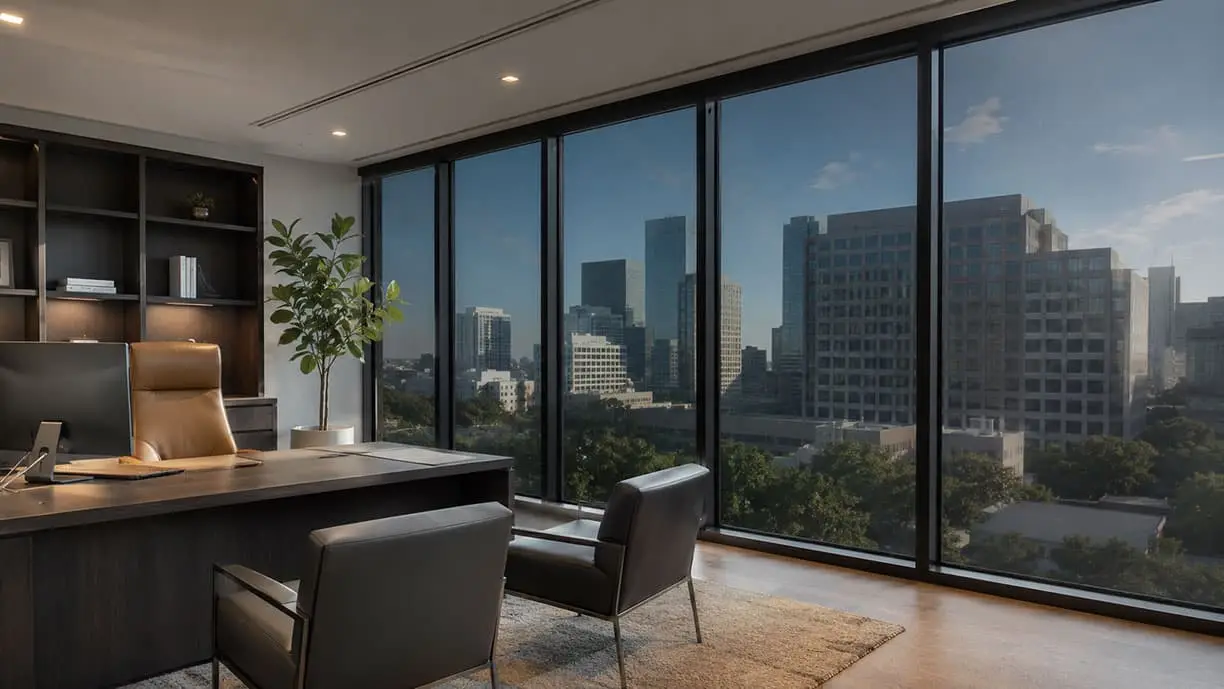
Window film turns hot, glare-filled office windows into comfortable, productive workspace. Greenhouse Solar Control installs office window tinting across Houston, TX to cut screen glare, lower solar heat, and reduce cooling costs for workplaces. Call (281) 961-3058 to request a quote or schedule a site assessment for your building.
What is office window tinting?
Office window tinting is a thin window film applied to the interior glass of a workplace. The film bonds to your existing windows, so there is no need to replace panes or reglaze.
Applied to the glass you already have
It works on the glass you already have, from single-pane windows to insulated double-pane units. That makes it a lower-cost upgrade than swapping the glass, because the current frames and panes stay in place.
Heat, glare, and UV control
Once cured, it filters incoming sunlight to manage heat and glare while preserving your outward view. The same film adds UV protection, blocking the majority of ultraviolet light before it reaches your interior. For a Houston office, that means steadier indoor temperatures and less afternoon sun on desks and monitors.
How can film help Houston offices?
Office film can address sunlight at workstations, glare on screens, or visual screening on interior glass. The useful benefit depends on the product and placement. A site assessment connects those requirements with daylight, exterior appearance, and the way employees use the rooms.
It lowers solar heat and cooling costs because it blocks a large share of the sun's heat before it enters, so your HVAC system runs less during long Gulf Coast summers.
It protects interiors from fading because it filters the ultraviolet light that bleaches carpet, upholstery, and wood finishes over time.
Steadier temperatures also help across an open floor, because the film narrows the gap between hot window seats and cooler interior desks. Comfort is only part of the picture, since many offices also want more control over what people can see through the glass.
How can film screen conference rooms and interior glass?
Open floor plans and glass-walled conference rooms bring in daylight, but they also expose meetings and workstations to view. Ground-floor and street-facing offices feel this most, since people outside can otherwise see straight into work areas. Privacy window film solves this by obscuring sightlines while still letting light through.
Frosted patterns and privacy levels
For conference rooms, frosted and etched patterns create a private, finished look without solid walls that would block that light. Gradient bands and full frosting give offices a range of privacy levels, and you can ask about custom branded graphics on your estimate. Browse our decorative & frosted window film for the pattern and opacity options that suit offices.
Beyond privacy, the right film depends on the problem you most need to solve, from heat to security.
Which film options suit office windows?
Office film options include solar-control products for exterior glass and decorative or privacy finishes for suitable partitions. The installer should compare the product with the actual glazing and sight lines. A single category label does not establish the right choice for every office window.
For heat and cooling control, solar and ceramic films reject infrared energy before it warms the room.
Dual-reflective films go further by adding a daytime privacy effect.
When summer heat and cooling bills are the priority, our commercial heat reduction options focus on rejecting solar energy.
For safety, commercial security window film bonds the glass together so it resists shattering from attempted break-ins.
For privacy on its own, frosted film gives a clean, opaque finish.
Films come in different visible-light levels, so a bright natural look and a darker reflective finish are both available. A single film across every window also keeps the exterior facade uniform from the street. A site assessment helps match the film to each window's exposure and use.
How does installation work in an occupied office?
Most offices stay open during a window film project. Our professional installation follows a set sequence so your team can keep working.
First, we complete a site assessment to measure glass, note sun exposures, and confirm film choices.
Next, we schedule the work in phases to limit disruption to staff.
On install day, technicians clean each pane, apply the film, and squeegee out moisture for a clear, bubble-free finish.
The work is low-mess and low-odor, so it keeps interference with a working office low. The film then needs a short curing period, during which any minor haze clears on its own. After it cures, routine glass cleaning keeps the film clear, and no special products are needed.
From your call to a finished install
On the calendar, the whole thing is shorter than most managers expect. We can book the site assessment the same day you call, and the install is usually scheduled 1 to 3 business days after you approve the estimate, which is the time it takes to confirm measurements and stage your film.
Most offices are then finished in a single visit: about 4 to 6 hours for a suite or a single floor, and 1 to 2 days for a larger office with a high window count.
Larger floors can be staged across several visits instead, and glass that needs a lift or has to be worked outside business hours adds to the plan rather than to the film.
How do you plan film around an occupied office?
Map the work areas and access windows before installation. Exterior glass may need solar control, while meeting-room partitions need visual screening. The installer can separate these requirements in the quote and agree on a sequence that keeps the affected areas available when needed.
For the wider service context, see commercial window film.
01 · Before you decide
Identify desks, equipment, blinds, and sensitive work areas beside the glass. Arrange permissions and access with the building manager before confirming the installation schedule.
02 · Details to compare
For this decision, compare screen glare, workstation use, meeting-room privacy, installation access. Bring the relevant details to the assessment so the recommendation addresses your actual property.
03 · The next useful step
Continue with our guide to commercial window-film pricing. It addresses a related part of the decision so you can check the scope before approving work.
What do Houston-area customers say?
Customers describe their experience with our communication, scheduling, and installation. These individual comments also appear on our reviews page.
★ ★ ★ ★ ★
“Greenhouse was great, I love my new system. Yousef was very informative and made the entire process easy. Highly recommend!”
★ ★ ★ ★ ★
“Nice guys, good job placing tint on our office windows & doors. Would recommend for anyone looking for tint!”
★ ★ ★ ★ ★
“They showed up exactly when they said they would and the work is phenomenal. They were able to match existing tint.”
★ ★ ★ ★ ★
“Communicative and efficient. A friend recommended them and I finally decided to reach out for tinting my patio window. I wish I would have done it sooner.”
Frequently asked questions
No. Many office films are lightly tinted or nearly clear, so they cut heat and glare while keeping the space bright and the outward view intact.
Yes. We plan the work in stages so your staff can keep working through the project.
Most offices are done in a single visit, roughly 4 to 6 hours for a suite or a single floor and 1 to 2 days for a larger office. Scheduling is quicker than that: we can book the site assessment the same day you call, and installation usually falls 1 to 3 business days after you approve the estimate.
Yes. Blocking a large share of solar heat eases the load on your HVAC system, which can reduce cooling bills during Houston summers.
Request a commercial quote
Greenhouse Solar Control provides office window tinting for workplaces across Houston, TX and nearby Katy, TX. We install office window film for a range of local workplaces, including medical suites, law offices, and open tech floors, where glare and privacy shape the workday.
We handle commercial window tinting for offices from single suites to multi-floor buildings, and our residential window tinting serves nearby homeowners. Request a quote through our commercial form, or call (281) 961-3058 for a free estimate and a site assessment. We will review your building, recommend the right film, and give you clear pricing before any work begins.